Every High Holy Day season, when I sit down to write a sermon, I ask myself, “What do I want to say? NEED to say?” and “Why do I want to say it?” To answer those questions, like most of my colleagues, I have a file filled with newspaper and magazine articles, quotes from books, speeches, online media, and recollections of thoughts and conversations. I begin collecting all that material even before the current High Holy Days are over.
It took almost a whole year for the following little nugget to arrive! Earlier this Summer, July 6 at 10:30 am PDT, the Earth reached its greatest distance from the Sun for the year, an expanse known as aphelion, 94 ½ million miles. Aphelion is the kind of occurrence that is hard to get one’s head around, even if it happens every year. It’s seemingly impossible to get one’s heart around something this grand. But we should. We should stop and smell the roses, all 94 ½ million miles of them. When the recent eclipse of the moon occurred, my son remarked, “Why do I get emotional looking at an eclipse?” I think we get emotional when we look at an eclipse, or consider aphelion, because these are events that put our lives into perspective. They push us back on our heels, compelling us to recognize that we are very small yet very significant in this Grand Oneness. Our lives are short and fragile, filled with foibles and pitfalls, inconsequential and consequential moments. Sometimes we don’t look up to see a lunar eclipse – or a sunrise, or a sunset, or a moonset in the morning. We walk past beautiful flowers or plants over and over. We don’t stop to greet our pets when they come over to us. Aphelion is a moment to stop, to step back, and get our hearts around our very brief and fragile existence as sentient human beings. So is a lunar eclipse. So is Shabbat. So is Rosh haShannah. This evening is Rosh haShannah and Shabbat, and…the 25th anniversary of the attack on September 11th. We’d better take a few steps back.
Besides the stepping-back moments that we all have in common, we also have heart-benders all our own. Here are a few of mine.
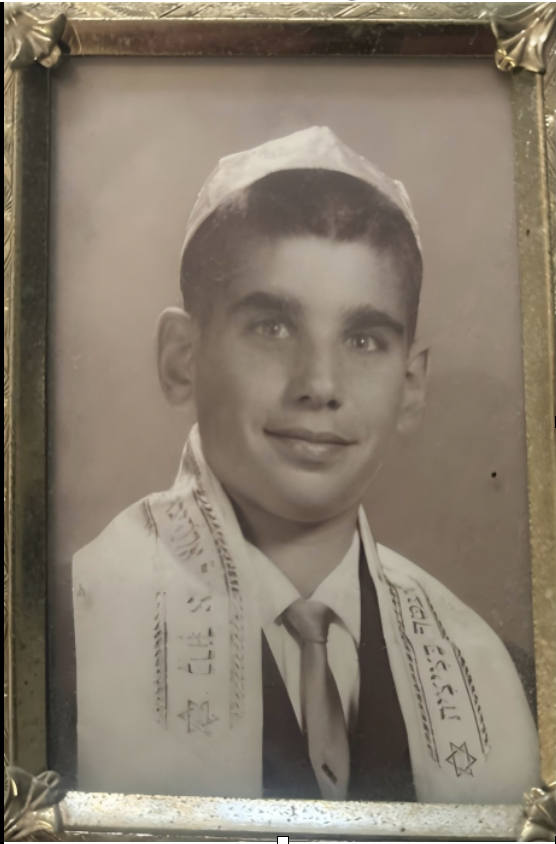
The first instance I recall as a semi-adult came shortly after I became a Bar Mitzvah, while I sat in a pew as a guest at a friend’s morning service.
I felt pretty confident (and maybe a little cocky) about reciting and singing the prayers, so much so that while I recited the Hebrew by heart, I decided to look at the English translation. I remember thinking, “If that’s what the Hebrew really means, I don’t believe it!” I stepped back to reflect on how this new understanding might affect my life. I decided I would stay involved with the temple, the choir, the youth group, and my Beatles cover band. At the same time, I would wrestle with the joy I felt singing all the traditional prayers and what I was discovering they meant. I was OK with that. I had my band, a girlfriend who dressed like Twiggy, and herring in cream sauce after every Bar Mitzvah. Life was good.
As an only kid, I was always looking for a brother, someone who could fill the role of advisor, confidant, guide, and more. I found him in our Temple Youth Group. His name was Phil Pill. I immediately looked up to Phil, who was two years older than I. We must have met right after I became Bar Mitzvah, when I turned 13, and Phil was 15. Phil always greeted me with a deep, sincere smile. He was charismatic. And he could really play piano. He could play any kind of music, but I particularly recall him playing jazz like an old master. He moved around quickly, and with purpose. Phil took me under his wing. He modeled for me the value of community, relationships, friendships, and integrity. His pop band was called Brandi Perry and the Bubble Machine.
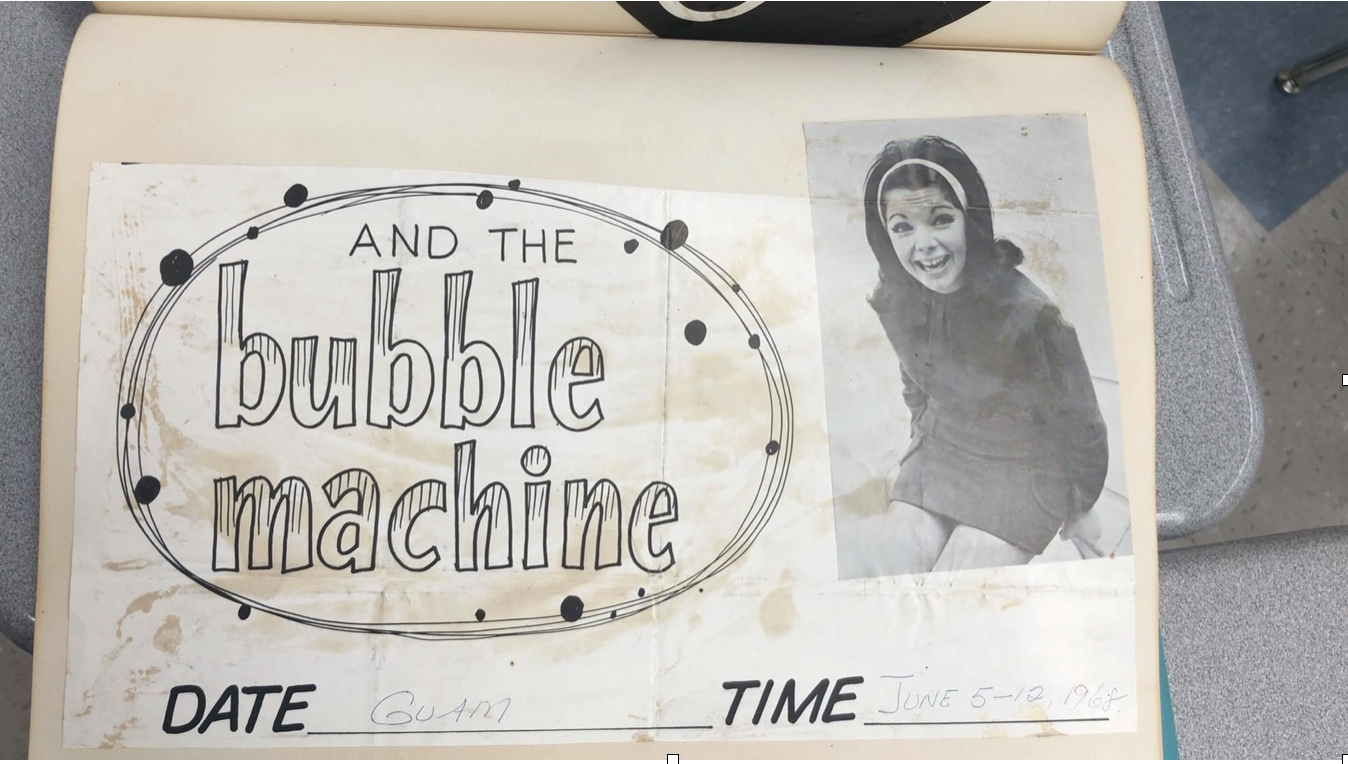
Brandi was the lead singer, but Phil was the band’s leader.
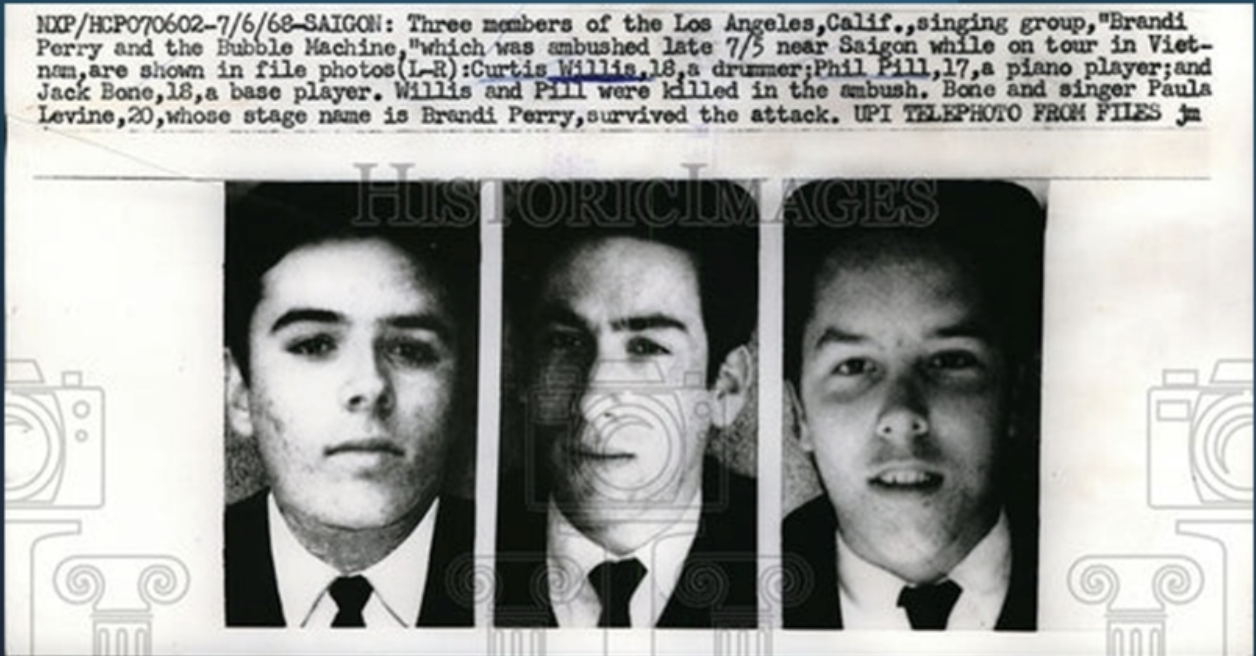
We were all very proud when Phil and his band received an invitation to entertain the troops in Vietnam in 1968. About a month after their arrival, the band was on their way to a USO concert when they were ambushed.
Phil and one other bandmate, the drummer, Curt Willis, were killed. (Phil’s in the middle of the picture below).
Every prayer that I read in the prayerbook that day at that other kid’s Bar Mitzvah came back to me. I was furious at the hypocrisy of the God our tradition proclaimed, who rewards those who are good and punishes evil. As far as I knew, Phil was everything good, and he was just 17 years old.
At that time, when everything seemed to be falling apart in the world, Phil was a ray of hope for a better future. Now, whatever he might have brought to the future, whatever music he might have played, literally and figuratively, was gone. Our youth director took me to meet with our rabbi, who sat back in his chair, crossed his arms across his chest, and asked, “So, Neil, what’s the problem?” I didn’t think I had a problem. I thought he had a problem. I thought the world had a problem. I didn’t answer his question. I shut down. I was done with people who were trying to give me an answer for the upside-down-ness and inside-out-ness of Phil’s death. This time I didn’t just take a step back; I stepped away. Once in a while, my parents would convince me to go to temple with them. I remember sitting there with my hands across my chest, staring – just staring. I stayed away from Judaism for 4 years.
A couple of days ago, on a lark, I looked up when the aphelion was in 1968. It was July 5th, the day Phil was killed. In fact, the Sun was even farther away from the Earth on July 5, 1968, than it was on July 6, 2026. Take another step back. Maybe a step-and-a-half.
During my first year in college, I was a pre-med major because, as my mother always told me, I was “going to be a doctor like my cousin Joel.” One day in chemistry class, we mixed various elements in a beaker. The assignment was to observe and quantify what happened in the container, but I was fascinated by the colors and the way the various components blended and didn’t blend – little rivulets of otherworldly shades falling into one another, what James Taylor calls “little pieces of everything.” About the same time as my excursion into the hues and textures in the beaker, my chemistry professor introduced us to the approximately equals sign, two horizontally parallel squiggly lines called tildes, like a wavy equals sign, except wonderfully weird and whimsical. Since that day, I loved the notion of “approximately equals.” Here, in the midst of the world of scientific facts, was an admission, a disclosure that we don’t know everything. I asked myself, “Why didn’t anybody tell me this before?! This little symbol says, ‘Let’s take a step back. Let’s be in awe of our humanity, our great strengths and our relative insignificance within the largeness of it all. Let’s motivate ourselves to turn an approximately equals sign into an equals sign while knowing there are many more things we can only approximate down the road. Scientists are wanderers and wonderers, always on a quest. We all should be.’” Take another step back.
Later that Summer, some friends steered me toward a job as a counselor at Camp Hess Kramer, a Jewish summer camp. Even though my Jewish identity and sense of belonging experienced some radical changes – changes that were still ongoing – I figured I could do the job because, after all, I was still Jewish! My cabin of kids was a motley crew of 10-year-old boys. I soon discovered they had the same questions, the same issues, the same anger, and the same sense that they were done with all the answers others were throwing at them. And they asked me for answers. Based on my own experience, I couldn’t. I wouldn’t do that. Instead, when they asked me about one of those heart-benders, I said, “Tell you what: I will help you find your answer today. And if that answer doesn’t work for you tomorrow, I’ll help you find another one.” Long story short, I fell in love with that kind of teaching, re-entered Judaism on my own terms, dropped chemistry, physics, and calculus, and eventually ended up in rabbinical school.
Children’s questions still push me back, along with the questions of people of all ages. I remain stunned and disappointed by the theology of the traditional prayer book, as well as by many attempts to revise and update it. Phil’s death convinced me to always step back and never avert my eyes from the folly of war and the deaths of innocents.
Someone always tries to convince us that this election is the most important election of our lifetime. I believe this election is. Before we step toward the voting booth or the mailbox, let’s take a step back. Let’s take two or three. This election is a heart-bender, a soul-bender. Let’s make sure that our family, friends, and neighbors take a step back, too. Let’s take a look at what’s really going on here. It’s not just the gold appliqué or the ballroom or the arch or even the war and its horrible consequences; it may well be about the destruction of democracy as we have known it. For Jews, our residence in this country has been the most successful and embracing experience the Jewish people have ever known in a host culture. And we owe it to America, to citizens of all backgrounds, spiritualities, races, sexual identities, and ethnicities, to our children, and our grandchildren to preserve this democracy. Although it’s been contested since the country’s founding, we affirmed voting as a right through the 15th and 19th Amendments and cemented it in place with the Voting Rights Act, or so we thought. We’re not done yet. Contemporary gerrymandering and other bigoted procedures operating under the guise of legality are wreaking havoc upon what this country decided to enshrine after a long, arduous and sometimes deadly process. The heavy importance of this election should push us back on our heels.
We are in a heart-wrenching moment. The future of American democracy is on the line. Bigotry is on the rise against Jews and many other minorities. Rhetoric and actions against immigrants and refugees are particularly vicious. We have detention centers? We’re still separating families and forcibly deporting people? Jews were in detention centers. Jews were deported, and our families were torn apart. America is supposed to be different. Over two and a half centuries, we worked hard to increase our moral clarity. 25 years ago, a few days after September 11th 2001, I commented on the hate and vengeance that were thick in the air of America. Hate and vengeance destroy clarity of thought, vision, and principles. Let’s vote to get that clarity back.
It’s Rosh haShanah. It’s Shabbat. It’s the 25th anniversary of 9/11. We just had a lunar eclipse. Aphelion happened earlier this Summer. Flowers on your block are screaming at you to see them. Step back. Take a good, hard look at our country and the world. Then, VOTE! Vote for the dignity of all people. Vote for the dignity of those who chose to come to these shores for a better life or for refuge. Vote for the dignity of the planet. Vote for the wonder and power of our diversity. Vote for the equality that we still need to create despite and because of our diversity. Vote for inclusion because we know the pain of being left out. Vote for love. Vote for peace. Vote like the future depends on it. It does.