
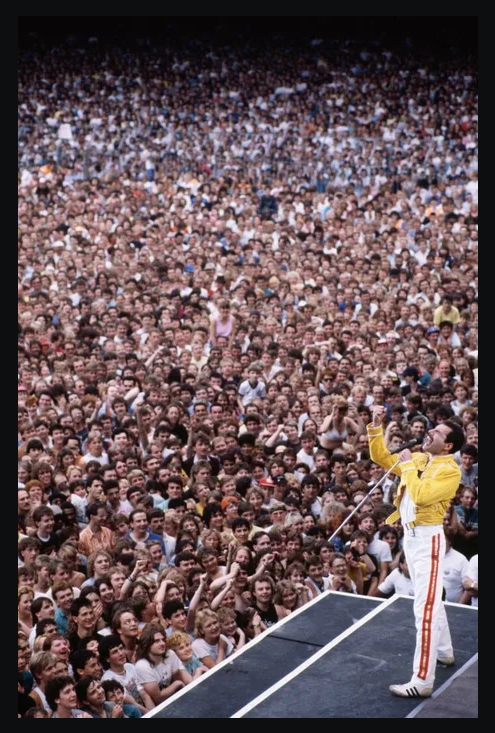
When did concerts go from this to…this?

When did standing in line at the grocery store stop being a moment to browse magazines and gum and turn into another few seconds to get a hit of our social media addiction?
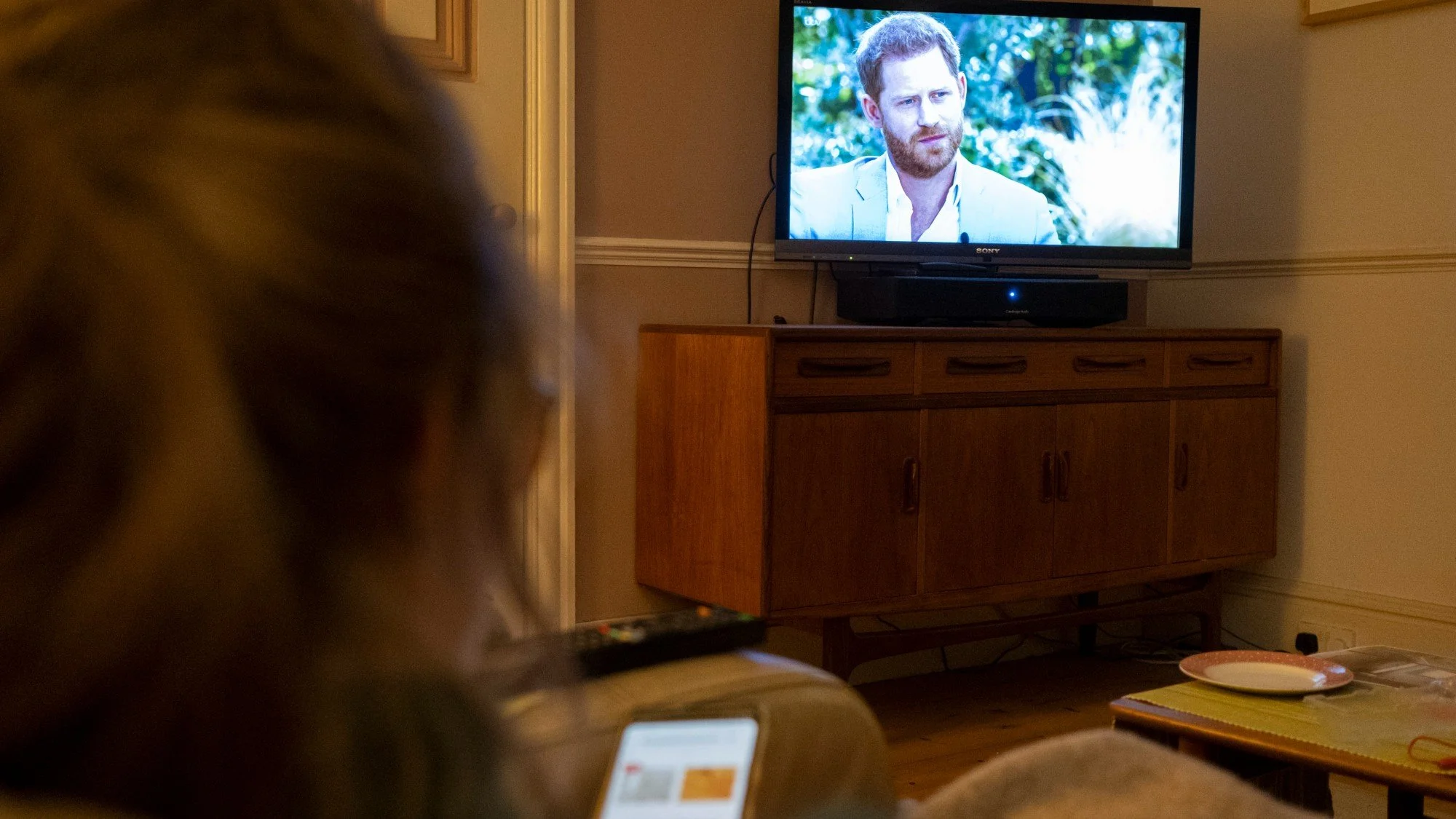
When did second screening - the phenomenon of watching TV and using our phone simultaneously - become so normalized that TV writers began simplifying scripts so distracted viewers could follow along?
Heck - we can’t even go to the bathroom without our phone - which - as an aside, is why our phones are dirtier than the soles of your shoes.
What has happened to us?
My wife and kids will tell you - I’m no expert at this. I struggle with the best of us to get away from my phone: from the doomscrolling, from the self imposed prison of being constantly available, from reaching for a little hit of dopamine every time I have a quiet moment.. This is a classic “rabbi-giving-a-sermon-he-needs-to-hear-himself” situation.
And I understand why I do it, at least. I feel a need to preserve the moment – or escape the boredom of a wait. I want to share an experience with friends and be able to look back on it later on. I want to make sure I’m not missing anything important for the community.
But there is something strange about taking out our phones to preserve a moment and consequently preserving a moment we never fully experienced. Or - making the effort to experience something and then choosing to not be fully present.
And this isn’t just about phones – though they have certainly exacerbated our problems. This is about our attention.
The French philosopher Simone Weil famously wrote that, “Attention is the rarest and purest form of generosity.”
We can be at the dinner table surrounded by family, without really being at dinner. According to a study released this summer, 75% of adults & 70% of kids reported using phones at the dinner table.
This pours over into the rest of our lives too. We can be at synagogue surrounded by community without really being in prayer. How many of us have reached for our phones since we’ve been here?
We can be sitting on the couch with the people we love most, watching a show we’ve waited for all week, and we may as well be in our separate rooms as we quietly stare at little screens to distract us from our screens. We place our bodies in the right place but we can’t seem to help ourselves from distracting our minds to oblivion.
I’m not exactly sure when we landed in this place - but we’ve been here for a number of years now. I know I wasn’t born into this world, but my kids were. I know I got to experience childhood without every adult in my life in a state of continuous partial attention. But I can’t point my finger to exactly when our new norm arrived.
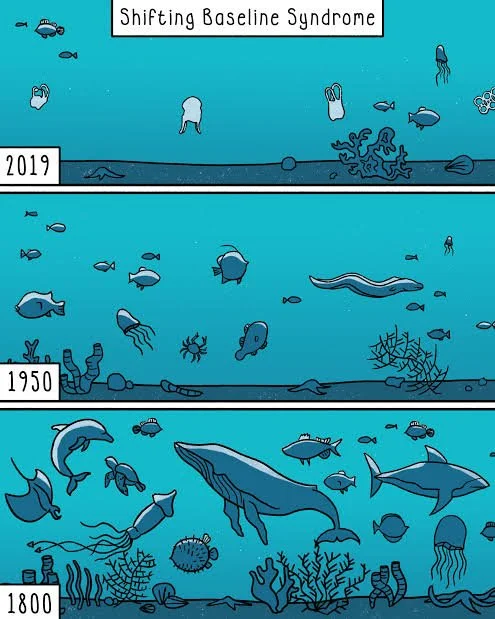
Environmental science utilizes a term that helps explain what is happening to us: shifting baseline syndrome.
Shifting baseline syndrome describes what happens when each generation accepts the world it inherits as normal.
In his book The Earth Said Remember Me, journalist Jason Dove Mark illustrates this with two stories. The first is the migration of Monarch butterflies. 50 years ago, the average count of Monarchs migrating through the West Coast was in the low millions - they were everywhere. By 2023, only 233k butterflies were counted.
A similar story is playing out in our rivers. When the first Europeans arrived in the Pacific Northwest, the number of fish was too numerous to count. When Lewis and Clark arrived at the Columbia River in 1805, they simply wrote: “The number is incredible to say.” Industrialization over the past 200 years has decimated the salmon population. In 1990, for example, just the sockeye population had fallen from historic highs at 40 million to just 2 million. Today, there are less than 280,000.
Today’s generation does not necessarily look at the river or the eucalyptus grove and say, “Something terrible has happened here.” They may see a few dozen salmon or a couple colorful monarchs and think, “Nature is amazing.” They do not remember what was lost because they never saw it. The baseline shifted.
Originally, I was inspired by the summer jaunt Maili and I took to the pacific northwest, and a book I picked up along the way. In reflecting on the natural world we grew up with and the significant changes that have happened during our lives, the author invites the reader to make a commitment to do what they can to stop the destruction and erasure of the natural world. That felt like a meaningful sermon - and it is!
But then I read this haunting quote – in the book – by psychologist Peter Kahn, who warns: “It’s not simply that we adapt to diminished nature, don’t know it, and do fine. Rather, we adapt, we don’t know it, and unknowingly do not flourish as individuals and as a species.”
I think that’s what’s happening to us today.
Shifting Baseline Syndrome helps us zoom out to understand the quiet destruction of the natural world, but I think it also applies to the slow shift we’ve all experienced in how we connect with one another in an era of screens. Though we human beings are incredibly adaptable, we can also adapt to conditions in which we are no longer flourishing, or in some cases, actively regressing and harming ourselves and the world around us.
This coming June will be 20 years with the iPhone & other smartphones. I didn’t personally have a moment when I realized we were off course. I’m not sure there was a single moment when we all consciously decided that those in front of us were less important than those in our pockets. We didn’t actively choose to become distracted, to turn away from connection for a quick dopamine hit. There was no moment of fissure where we shifted our attention to our phones instead of our partners and children. We didn’t choose a world where we are always professionally available, where work doesn’t stay at the office, and we feel an obligation in our time off to check our email and respond. This expectation of availability, the phone vigilance & phantom buzzes, all contributes.
It all happened gradually. The baseline shifted. Our attention slowly evaporated.
In Rabbi Lawrence Kushner’s telling of the burning bush, the story is actually about attention. Moses is tending sheep in the wilderness when he sees a bush aflame. And we know, famously, the bush is not consumed. We usually call this spectacle a miracle. But…How long would Moses have needed to watch the bush before he could know it was not being consumed?
Wood does not quickly disappear when it catches fire. Even a small bush would burn at minimum for several minutes. If you were walking past a burning bush, you might think, “Huh, that’s probably not good,” and keep moving. But Moses does something different.
The Torah says: “Moses said: I must turn aside and see this great sight. Why is the bush not consumed?” I must stop my journey, turn aside, and pay attention to this bush.
The Torah then tells us: “When God saw that [Moses] had turned aside to see, God called to him from within the bush: Moshe, Moshe. [And Moshe] answered, Hineini - “Here I am.””
God calls to Moses only after Moses turns aside to pay attention to the bush. Kushner suggests that the miracle was not really the bush – it was Moses’ attention. He paid attention long enough to notice that something extraordinary was happening.
How many of us have that attention span today? Would you have turned aside to pay attention, or hurried by?
Later, when God tells Moses, “Come up to Me on the mountain and be there,” the Rabbi Menachem Mendel of Kotzk asks why God needs to add “be there.” He answers that “people often expend great effort in climbing a mountain, but once they get there, they’re not there; they’re somewhere else!” Moses wasn’t immune to the same struggles with attention we have – even in the presence of God!
God doesn’t only say to Moses, “Come up.” God has to say, “Be there.” If Moses - the greatest of our prophets and teachers - couldn’t give his undivided attention to God - what chance do we have?
Perhaps this helps us better understand Simone Weil when she writes that “attention is the rarest and purest form of generosity.”
Even Moses needs to be reminded to be present where he is. To not simply climb the mountain, but to arrive. To not simply pass the bush, but to turn aside and look. If Moses needs that reminder, I think we can forgive ourselves for needing it too.
And Weil takes this idea even further. She writes: “Attention, taken to its highest degree, is the same thing as prayer.”
I love that idea. We – especially as Jews with our ordered prayer – tend to think prayer is what happens when we say the right words in the right order at the right time. But Weil suggests that prayer happens whenever we become truly present. Whenever we stop centering ourselves long enough to really see what’s in front of us.
Whenever we quiet the noise and pay attention to something beyond ourselves, we connect with the divine. Whenever we really pay attention to someone, we connect with the divine within them. And when we don’t, when we normalize continuous partial attention, we miss that surge of divine energy between us and our partners, our kids, our friends, our world.
There is a haunting midrash in Kohelet Rabbah that imagines God taking Adam through the Garden of Eden, showing him all the trees, and saying: “See My creations, how beautiful they are. Everything I created, I created for you. Make certain that you do not ruin and destroy My world, for if you destroy it, there will be no one to mend it after you.”
Then the midrash tells a strange and painful story. A pregnant woman is imprisoned. She gives birth to a son and raises him there. One day, after her death, the king passes by, and the child cries out: “My king, I was born here. I grew up here. I do not know what sin I committed that caused me to be imprisoned.”
The king answers: “It was not your sin. It was your mother’s.”
The sages are asking us to recognize that every generation is born into a world shaped by the choices of the generations before it. And that is the danger of a shifting baseline.
Our children did not create a world of constant distraction. They did not decide that every quiet moment needed to be filled, that every experience needed to be documented, or that everyone should be reachable at every hour of the day. They were born into the world this way. This is the world we handed them, and because it is the only world they have known, it feels normal.
I do not want to overstate the metaphor. A smartphone is not a prison. But a life in which we cannot be alone with our thoughts, cannot sit through a meal without checking a screen, and cannot give the person in front of us our full attention can become its own kind of confinement.
And if we are not careful, our children may inherit that confinement without remembering that another way of living, and another way of connection, was ever possible.
As Aria and Caleb get so big, and seriously, what business do they have being in fourth and second grades, I find myself increasingly distressed by the many moments when I was present in body but not in mind. There was a cute baby right in front of me, and somehow I put my phone between us. Somehow I still put my phone between us.
I cannot get those moments back.
And I think by now, I would know that life is not about recording moments but experiencing them. It is not about constant connection or instant gratification, but the slow burn of our relationships, and our relationships are shaped by the attention we give them.
The baseline shifted through small choices. We gave our attention away a few seconds at a time and perhaps we can begin to reclaim it the same way.
So in this year, in 5787, when we reach for our phone, may have the discipline to leave it in our pocket, and say Hineni - in fact, I am going to be present here, in this moment, with these people and I refuse to be distracted.
God doesn’t only tell us to show up. God tells us to be present.
To a year of attention to the things that truly matter and a year of being present for ourselves, our loved ones, and our world.
L’Shanah Tovah U’Metukah!